

INTRODUCTION
Pakistan’s solar industry is entering a new phase. While solar panels remain the foundation of clean energy, 2026 is shaping up as the year of solar batteries.
With:
- Possible changes in net metering policies
- Rising electricity tariffs
- Frequent load-shedding and voltage issues
More homeowners and businesses are now investing in solar energy storage systems instead of relying entirely on grid exports.
This blog explains why solar batteries are booming in Pakistan, which battery type is best, and how buyers can choose the right solution in 2026.
WHY SOLAR BATTERIES ARE GAINING POPULARITY IN PAKISTAN
1️⃣ Net Metering Uncertainty
As discussed in recent policy debates:
- Exporting excess solar power may become less profitable
- Self-consumption is becoming the smarter strategy
Solar batteries allow users to store excess energy rather than sell it cheaply.
2️⃣ Load-Shedding & Grid Instability
Despite solar growth:
- Power outages continue
- Voltage fluctuations damage appliances
- Businesses cannot afford downtime
Battery-backed solar systems ensure continuous power, day and night.
3️⃣ Rising Night-Time Electricity Costs
Electricity tariffs in Pakistan are:
- Higher during peak hours
- Increasing every year
Stored solar energy significantly reduces nighttime electricity bills.
LITHIUM VS LEAD-ACID BATTERIES: WHAT’S BEST IN 2026?
Lead-Acid Batteries (Traditional)
Pros:
- Lower upfront cost
- Easily available
Cons:
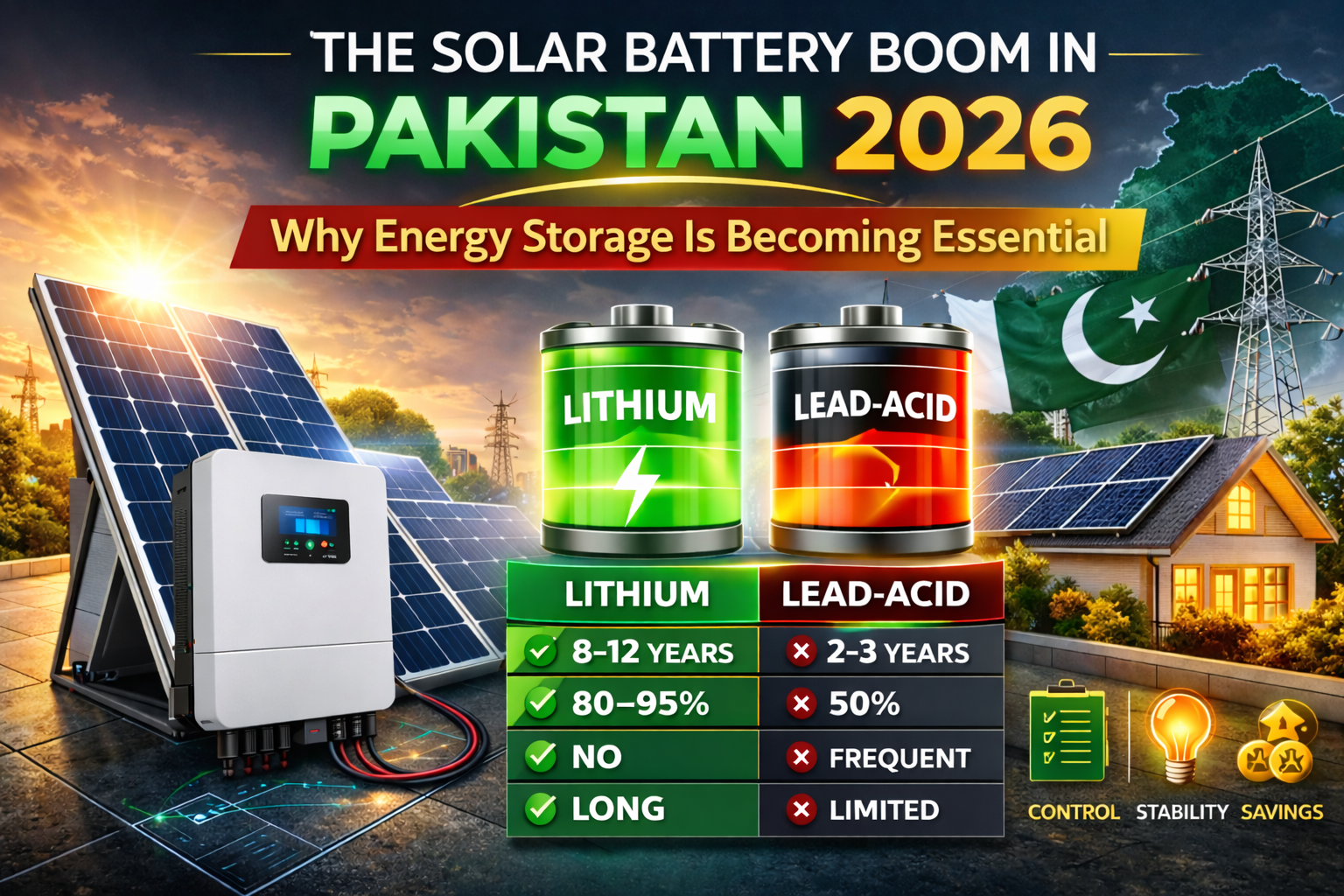
- Short lifespan (2–3 years)
- Limited depth of discharge
- Regular maintenance
- Heavy and space-consuming
Lithium Batteries (Modern Choice)
Pros:
- Long lifespan (8-12 years)
- 80-95% usable capacity
- Faster charging
- Maintenance-free
- Compact and lightweight
Cons:
- Higher initial cost
👉 In 2026, lithium batteries offer better long-term value, especially for serious solar users.
WHY HYBRID SOLAR SYSTEMS ARE THE FUTURE
Hybrid systems combine:
- Solar panels
- Grid connection
- Battery storage
They allow users to:
- Use solar directly
- Store excess energy
- Use the grid only when necessary
👉 Internal link suggestion:
OAX Hybrid Solar Inverters – Smart Energy Control
HOW TO SIZE A SOLAR BATTERY IN PAKISTAN
Before buying a battery, consider:
✔ Daily Night-Time Usage
Fans, lights, fridge, AC, routers, CCTV
✔ Backup Duration
Do you need:
- 4–6 hours?
- Full-night backup?
- 24-hour independence?
✔ Surge Load
Appliances like:
- Air conditioners
- Water pumps
- Motors
require higher discharge capability.
COMMON MISTAKES PAKISTANI BUYERS SHOULD AVOID
❌ Buying a battery without a proper BMS
❌ Choosing a battery incompatible with the inverter
❌ Overspending on capacity you don’t need
❌ Ignoring warranty and after-sales support
WHAT THIS MEANS FOR PAKISTAN’S SOLAR FUTURE
Industry trends show:
- Rising lithium battery imports
- Growing demand for behind-the-meter storage
- Shift from export-based ROI to storage-based savings
Solar batteries are no longer optional; they are becoming standard.
FREQUENTLY ASKED QUESTIONS (FAQs)
Are solar batteries worth it in Pakistan in 2026?
Yes. Especially with rising tariffs and uncertain returns from net metering.
How long does a lithium battery last?
Most quality lithium batteries last 8-12 years.
Can I add a battery later to my solar system?
Yes, if you use a hybrid inverter.
Are lithium batteries safe?
Yes, when equipped with proper Battery Management Systems (BMS).
FINAL THOUGHTS
Pakistan’s solar market is evolving from power generation to power management. Solar batteries give users:
- Control
- Stability
- Long-term savings
In 2026, the smartest solar systems are those that store energy, not waste it.
If you’re planning solar today, think beyond panels; think storage.